

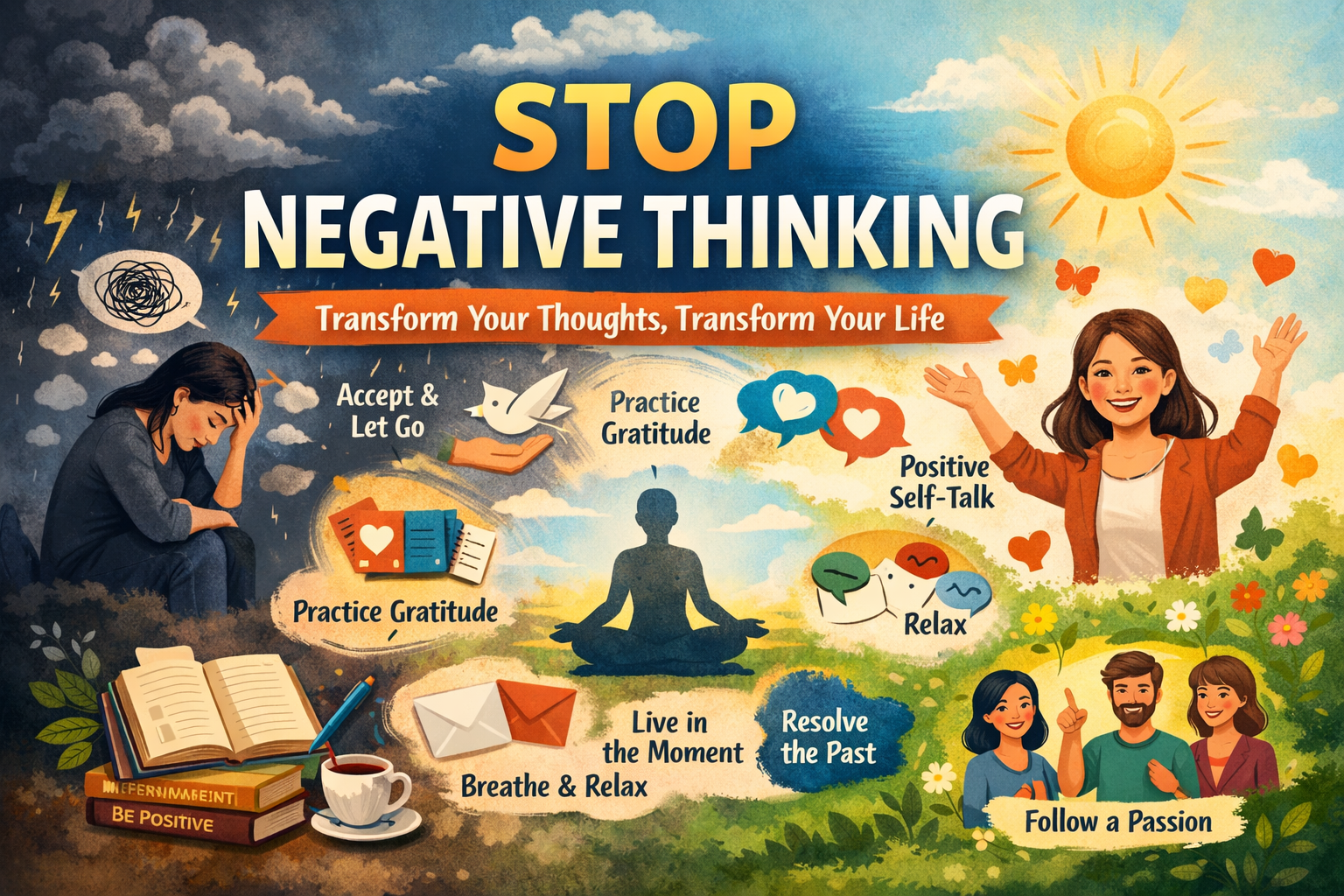
Stop Negative Thinking
 Stop
Stop
Negative Thinking
Thinking is a natural process. From the time we wake up till the time we go to bed, thoughts robotically arise and subside in our mind without any respite. Majority of these thoughts are useless and negative. They deplete us of our energy and lead to stress, restlessness, anxiety, depression, mental fatigue and poor health. Occasional negative thoughts are normal, but when negative thoughts occur to the extent that they begin to affect physical and mental health and keep an individual from leading a normal healthy life, it should be considered a warning sign that needs to be addressed.
Life changing stressful events can create negative thoughts that lead to fears, anxieties and depression. Repeated negative thoughts over time become habitual and soon negative thoughts just pop into the mind, without the need of any outside triggers. Such thoughts are termed automatic negative thoughts. Most often these thoughts are irrational and are based on assumption. They lack factual backing and objectivity. Such thinking is referred to as cognitive distortion. They cloud our judgment, mislead us into doing regrettable actions and delude us into viewing things in a negative light.
6 Common Signs of Negative Thinking:

- Internal chatter: You find yourself engaged in destructive internal chatter and tend to replay negative events from your past or play out negative imaginary events and conversations with people.
- Suspicious: You tend to be suspicious of the motives of
 people and suspect that there is a hidden agenda behind everything people say or do.

- Cynical: You have a tendency of focusing only on the negative aspects of people and are into fault finding, whether real or imaginary. You find it hard to focus on the positive aspects of people and are always criticizing them, for their mannerisms, their looks, their clothes, their choices and decisions.
 Gossiping: When you share a personal story with someone with the intention of easing your sorrow and finding some respite it is not gossiping, but when you take pleasure in recycling a story over and over again and embellishing it by magnifying negative aspects of the story and playing down the positive ones, in order to justify your position, that qualifies as gossip. While gossiping might provide you a temporary outlet to vent and also give you some momentary sense of satisfaction, it actually stirs up more negative emotions, and leaves you feeling worse than before. If you absolutely must gossip, then gossip about something good.

- Fearing the worst: You see danger in even simple day to day mundane activities and tend to play out events in your mind by imagining the worst possible scenarios and outcomes.
How to Stop Negative Thinking | Techniques
Our negative emotions are so powerful that constant effort is needed in order to counteract them. If we practice constantly, then we can definitely change.
Acceptance:
It is important to understand and accept that what we are today is a result of our own actions and the choices we made, since all our actions and choices have their origin in our thoughts. There are things that are out of our control that we cannot change and then there are things that we can change. Focus on the things that you can change. Quit wrestling with life and learn to go with the flow. Negative thoughts of jealousy and hatred are merely a reflection of one’s own insecurities. For example: if one has always struggled with weight, they would tend to look at all slim people with jealousy and dislike. If one does not feel beautiful, they will perceive beautiful people as conceited and will purposely ignore them. If someone is wealthy, then the financially insecure, will naturally perceive such people as being arrogant and will try to put them down in order to level the playing field for themselves.


Attitude:
The mental attitude with which you begin your day is a good indicator of how the rest of your day would go. Take a mental note of your attitude and feelings when you wake up in the morning. What is the quality of the thoughts that run through your mind? Is it one of anger, self pity and unhappiness or one of gratitude, contentment and hope? Does your mind feel agitated or does it feel calm? Are you dreading the day or looking forward to it? Once you have answered these questions for yourself, you will realize that it is actually your own attitude that determines the course of your day and not the people and circumstances surrounding you. It is very important to remember that the first 5-10 minutes of every morning are crucial in establishing that positive frame of mind. So do a ‘thought quality check’ and smile first thing in the morning.

Analysis:
Analyze your thoughts closely. Every time a negative thought comes into your mind, ask yourself if it is real or imaginary; whether it is based on fact or assumption. Toss out all thoughts that have no factual basis. If a thought is based on fact, ask yourself if it is toxic or healthy. If it is toxic don’t fuel it. Remind yourself that this thought contributes nothing towards your good health and happiness and then let it go.
Counter negative thoughts, words and actions:
 Improper thoughts and actions of violence done directly or indirectly and which are caused by anger, delusion or greed, in any degree whatsoever always result in unending pain and misery. When the mind is disturbed by improper thoughts or emotions, one can help restore the peace of mind by contemplating on the opposite thought or emotion. So one would counter the emotions of hatred with love, anger with peace, vice with indifference and misery with compassion. Try to put yourself into the practice of using only positive words. Replace negative words, with positive ones. Using negative and harsh words will only add to your already agitated state of mind and leave you depleted. Think before you speak. In a nutshell, if you have nothing good to say, don’t say it. If a negative thought arises, do not fuel it. Don’t criticize or judge anyone, including yourself. Remember, when you wish good for someone from the bottom of your heart it has a positive effect on you and when you project hatred and jealousy it only returns to you with greater force.
Live in the Moment:
 By no means should this be misconstrued as an excuse to adopt an irresponsible, overindulgent or unhealthy lifestyle. The key message here is to learn to enjoy life in the moment without mentally spacing out.
Dwelling in the past only brings anger and disappointment and worrying about the future only brings anxiety. Learn to develop awareness in everything you do, instead of doing it mechanically. If you ever notice yourself feeling agitated, or if you feel a tense moment coming up, bring your attention immediately to your breath and any tense spots in your body. Breathing tends to become shallow during stressful moments. Immediately revert to the slow relaxed deep breathing while keeping your focus on your inhalation and exhalation. Completely relax your body. Slow down your daily pace. Your breath, mind and body are like cog wheels. What happens to one affects the other two. A gentle breath equates to a calm mind, which equates to gentle words and actions and vice versa. Similarly, an agitated breath equates to an agitated mind, which equates to harsh words and regrettable actions. Our breath operates only in the present moment; not in the past and not in the future. Hence focusing on one’s breath can help steer the mind back to the present. As simple as it sounds, this will of course require skill and sincere practice of awareness and implementation.
 Resolve Past Issues:
Suppression of emotions and not speaking up leads to resentment. Repressed emotions tend to resurface sooner or later when an event triggers the memory. If possible it is best to resolve past issues in a civil manner with the people involved. If too much is at stake and this is not an option then writing about it in a journal can prove highly cathartic. Writing will purge your mind of the burden of carrying these thoughts with your everyday.
Express Gratitude:
 Learn to practice gratitude in everyday life. There are two ways of doing this-being grateful for all the wonderful things you have and being grateful for all the pain and suffering that you do not have. Think of all the problems people around you have, that you don’t. Ask yourself if you would be willing to trade places with someone and take on their pain and suffering in exchange for yours.
 Seek Positivity:
Surround yourself with positive people. Read books and articles that promote positivity and inspire you to stay positive. Don’t take seriously anything that negative people say to you as they only speak from their own insecurities. People generally say things to pull you down in order to level the playing field for themselves. Don’t place your happiness in the hands of such people. Learn how to be indifferent to comments from such people or better yet try to avoid the company of negative minds.
Give your mind a purpose:
Follow a hobby, or do something you loved to do as a child. Pursue something you have always passionately desired to do, but kept putting off because life got in the way. This will give your mind a purpose and keep it from straying to negative thoughts.

If you are suffering from negative thinking I hope you will put the advice given above to good use. Even implementing a few of these techniques would be helpful in breaking the negative thought patterns and ushering in positive thinking.