
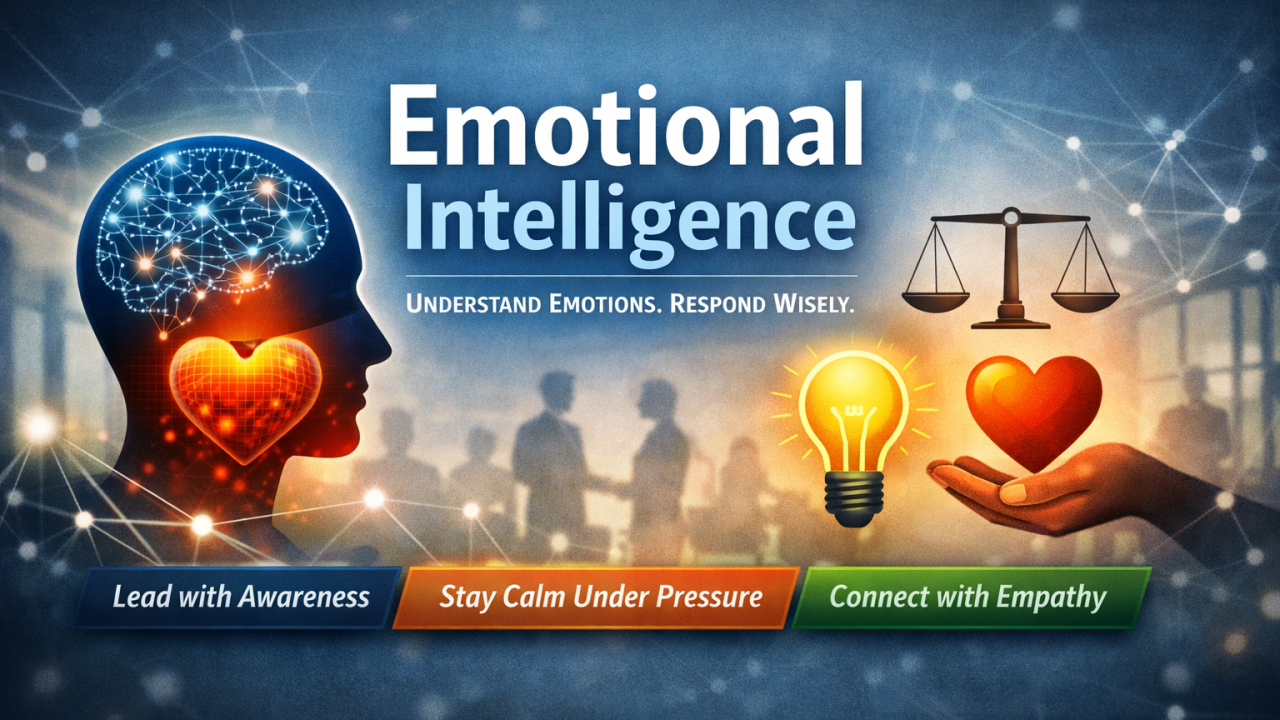
“Before Emotional Intelligence — Understand Emotion” - Define it. Then lead it.
Emotional Intelligence starts with one thing:
Understanding emotion itself.
Before we regulate emotions, we must understand what they are — and what
They are not.
Emotions are not weaknesses.
They are biological signals.
In psychology, emotions are:
Brief, automatic physiological responses designed to help us survive and adapt.
They involve:
• Body reactions
• Brain activation
• Action tendencies
Emotion is data.
Emotions are not:
• Thoughts
• Stories
• Beliefs
• Personality traits
Example:
Thought: “No one respects me. ”
Emotion: Hurt. Anger. Shame.
Thoughts are interpretations.
Emotions are felt experiences.
Practical Examples
Your email receives no reply.
Thought 1:
“They’re ignoring me. ”
Emotion: Anxiety.
Thought 2:
“They’re probably busy. ”
Emotion: Calm.
Same event. Different thought. Different emotion.
This is the foundation of cognitive psychology.
Types of Emotions
Most research identifies core emotions such as:
• Joy
• Sadness
• Fear
• Anger
• Disgust
• Surprise
(Found in cross-cultural research, e.g., Paul Ekman).
Everything else is often a blend or variation.
Burnout, for example, is not a single emotion. It is prolonged stress + emotional exhaustion.
The Brain and Emotion (Simple Neuroscience)

Our brain processes emotion in layers:
1-Reptilian Brain Instinct and survival.
2-Limbic System Emotion processing (including the amygdala).
3-Prefrontal Cortex Reasoning, planning, regulation.
The Amygdala Hijack
– Coined by Daniel Goleman.
An “amygdala hijack” happens when: The emotional brain overrides the thinking brain.
You react before you reflect.
This looks like:
• Snapping under pressure
• Defensive decision-making
• Escalating conflict
Emotional Intelligence restores the pause.
The Cognitive Triangle

In Cognitive Behavioral Psychology, we use the Cognitive Triangle:
Thoughts → Emotions → Behaviors
They constantly influence each other.
Change the interpretation, and you influence the emotional outcome.
Why This Matters?
Those who cannot distinguish:
• Thoughts from emotions
• Signals from stories
Will manage stress reactively.
Those who understand emotion:
Manage energy.
Prevent burnout.
Make clearer decisions.
Emotional Intelligence begins here.